
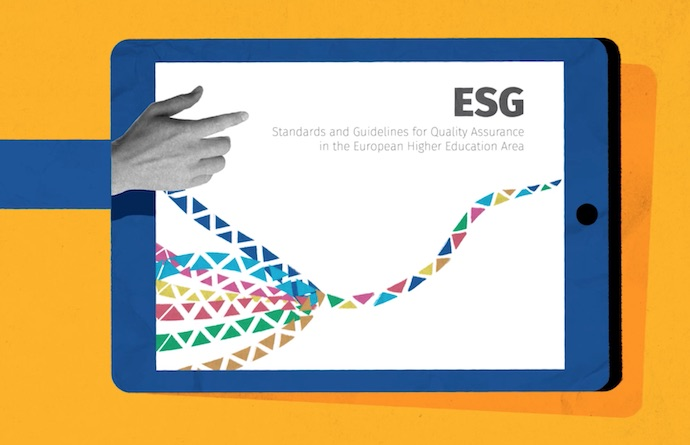
At a time when higher education is facing profound academic, technological, and societal transformations, universities that aim to be competitive and credible at the international level must build their systems on clear quality standards In this context, Haxhi Zeka University in Peja considers the respect and implementation of the Standards and Guidelines for Quality Assurance in the European Higher Education Area (ESG)) as one of the main pillars of its institutional and academic development.
The ESG represents the main European framework that guides universities in organizing their quality assurance systems, ensuring that academic processes are student-centered, supported by clear learning outcomes, and connected with social and economic developments. For Haxhi Zeka University, these standards do not represent only a formal requirement of accreditation systems, but rather a philosophy of institutional development that aims at the continuous improvement of the quality of teaching, scientific research, and service to society.
In this direction, the university has undertaken a series of reforms aimed at harmonizing academic processes with the principles of the ESG. One of the main directions of these reforms is the development of a student-centered teaching model, where the learning process is not limited only to the transmission of knowledge, but is focused on the development of analytical, professional, and interdisciplinary competencies. Through the updating of curricula, the integration of contemporary teaching methods, and the strengthening of the practical component in study programs, Haxhi Zeka University aims to ensure that students are prepared for the real challenges of the labor market and society.
Another important dimension of implementing the ESG standards is the establishment of a sustainable internal quality assurance system. The university has developed institutional mechanisms that continuously monitor the functioning of study programs, the academic performance of students, the effectiveness of teaching methods, and the professional development of academic staff. These mechanisms are oriented not only toward identifying challenges, but also toward creating an institutional culture of continuous improvement.
At the same time, the university places special importance on the involvement of stakeholders in academic development processes. Cooperation with the private sector, public institutions, and international partners helps ensure that study programs reflect the real needs of society and the economy. This approach contributes to increasing the relevance of university studies and improving the employability of graduates.
Digital transformation also represents an important element in the modernization of the learning process in accordance with European standards. The integration of digital teaching platforms, the development of technological laboratories, and the inclusion of digital competencies in study programs are part of the university’s efforts to build a modern academic environment oriented toward innovation.
The commitment of Haxhi Zeka University to quality is not limited only to the implementation of existing standards. The university also closely follows new developments within the framework of the Bologna Process and the ongoing review process of the ESG standards, which is expected to conclude with the adoption of a new version of these standards in 2027. The institution is committed to adapting its academic policies and practices in accordance with these developments, ensuring that its quality assurance system remains aligned with the most advanced practices of the European Higher Education Area.
In this way, Haxhi Zeka University aims to strengthen its position as a modern and trustworthy higher education institution that builds its future on the principles of quality, transparency, and academic responsibility. Through its continuous commitment to European standards and its readiness to adapt to new developments, the university aims to contribute to the development of higher education in Kosovo and its integration into the European academic area.