
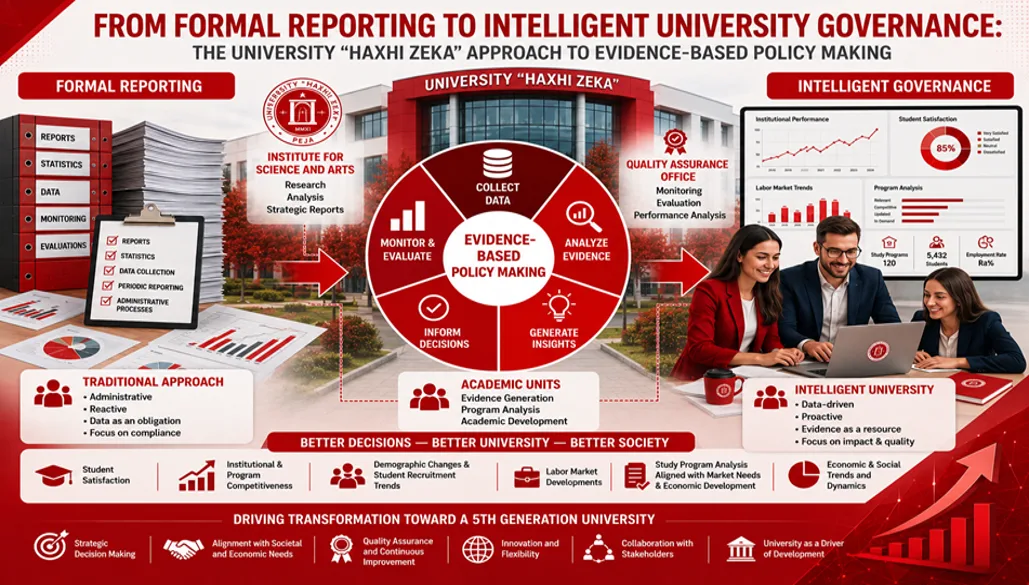
University “Haxhi Zeka” has, in recent years, undertaken a significant transformation in the way it approaches university governance, gradually shifting from formal reporting practices toward a model grounded in Evidence-Based Policy Making (EBPM). At a time when public universities are facing increasing demands for quality, transparency, relevance, and public accountability, this approach represents one of the most modern and forward-looking forms of higher education management.
A particularly important role in this transformation has been played by the Institute for Science and Arts of the university, which has continuously produced high-level scientific analyses, reports, and strategic documents aimed at supporting institutional development and strengthening the university’s connection with broader social, economic, and academic developments. Through its research-oriented and analytical approach, the Institute has helped cultivate an institutional culture in which decision-making is guided by empirical data, comparative analysis, and systematic institutional reflection rather than by administrative routine alone.
An equally valuable contribution has come from the Office for Quality Assurance, whose continuous analytical reporting, institutional monitoring, and internal evaluation processes have supported the university in identifying challenges, measuring performance, and shaping its developmental policies. At the same time, the academic units of the university themselves have activated a range of institutional mechanisms for generating evidence and conducting analyses necessary for academic and strategic development.
Within this broader framework, the university has carried out ongoing analyses related to student satisfaction throughout their studies, institutional and program competitiveness, demographic changes, student recruitment trends, labor market developments, and the alignment of study programs with real economic and societal needs. These findings have not been treated merely as formal reports or administrative statistics, but rather as practical instruments for shaping academic policies, reviewing curricula, strengthening institutional capacities, and guiding long-term strategic planning.
This continuous orientation toward analysis, institutional reflection, and evidence-based decision-making is gradually positioning the University “Haxhi Zeka” as a modern fifth-generation university — one that is flexible, innovative, interactive, and capable of responding to the dynamic transformations of society, the economy, and the global knowledge market. In this model, the university no longer functions solely as a traditional teaching institution, but as an intelligent and adaptive organization that continuously learns from the data it generates, from the needs of society, and from the evolving realities of the contemporary world.